Vertical AI Agents: 7 Use Cases That Work in 2025
09.12.2025 | 8 min read



AI agents are finally doing real work instead of just chatting. These specialized systems, called vertical AI agents, handle complete workflows in specific business areas. They're not generic assistants trying to do everything. Instead, they focus on one domain and get really good at it.
The secret to their success? A smarter way of handling information. Modern vertical agents organize data like files on a computer. They create structured workspaces they can navigate and search efficiently.
This approach shows cost-per-task reductions of over 40% in real deployments while improving results (source: arXiv).
What Are Vertical AI Agents?
Vertical AI agents are AI systems built for specific industries or business functions. They understand the specialized language, workflows, regulations, and data structures unique to their domain.
Here's what makes them different:
Instead of trying to remember everything or searching through massive databases, they organize information in directories. When they need something specific, they know exactly where to look. Just like you'd go straight to a folder on your computer instead of searching every file.
AI-powered agents in specialized domains can operate at a cost of $0.25–$0.50 per interaction, significantly less than traditional agent calls (source: teneo.ai).

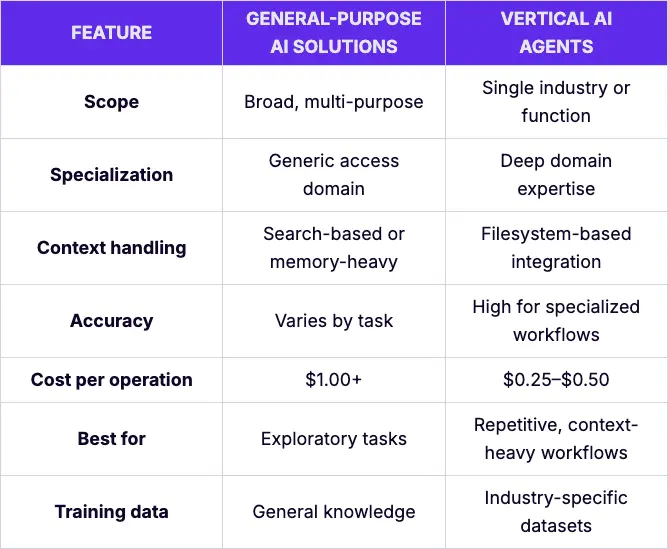
Horizontal AI like ChatGPT handles broad tasks across industries. It's versatile but lacks depth. Vertical AI agents are specialized in single domains with deep expertise.
Y Combinator and Bessemer Venture Partners predict the vertical AI market could reach 10 times the size of SaaS, potentially creating $300 billion+ companies. This projection reflects vertical AI's ability to automate complete workflows and replace labor costs, not just software subscriptions.
7 Use Cases for Vertical AI Agents
The rise of vertical AI agents shows how specialized AI systems designed for specific industries outperform general-purpose tools. These agentic AI solutions integrate directly into workflows and automate complete processes with industry expertise. Here are seven areas where vertical AI could deliver or is already delivering results.
1. Sales Intelligence Agents
When you're preparing for a client meeting, these agents build a complete picture. They organize call transcripts by date, separate internal notes from client conversations, and connect deal data with relationship history.
Then they run targeted searches: finding pricing discussions from recent calls, identifying commitments from Slack, pulling current deal status. The output is a focused brief showing renewal timing, unresolved issues from months ago, and which stakeholders haven't been engaged recently.
Companies using these agents report 30% shorter deal cycles because sales reps have full context without spending hours hunting for information.
Sales teams have information scattered everywhere: call recordings, Slack messages, CRM data, emails. Sales intelligence agents organize all this into a workspace that mirrors your account structure.
2. Content Strategy Agents
Marketing teams need to create consistent content across multiple channels while staying aligned with brand guidelines and past messaging. Content strategy agents treat your content library like an organized knowledge base.
They organize existing content by type, topic, and audience. Before writing anything new, they review your style guide, check recent posts for tone consistency, and verify product details for accuracy.
When you need a LinkedIn post about a new feature, the agent reviews your positioning docs, sees how you've discussed similar topics before, uses approved messaging, and delivers something that sounds like your brand because it actually read everything you've published.
3. Customer Support Agents
Support documentation grows messy. Knowledge sits in people's heads. Customer support agents using organized information systems change this.
These agents maintain structured repositories: product docs, known issues, solution guides, and customer configurations. When a ticket about API authentication arrives, they navigate to authentication docs, check known bugs, review procedures, and pull that customer's specific setup.
A customer on a legacy version with custom configuration gets different steps than someone on the current version. The agent knows this because it organized the information properly.
Teams using these agents see faster first responses with better accuracy. Support staff focus on complex problems while agents handle straightforward issues.
4. Research Agents
Market research and competitive analysis generate huge amounts of information that needs synthesis. Research agents maintain structured investigation workspaces.
Instead of dumping every search result into one place, these agents create organized folders by research topic. Regulatory findings go in one folder, competitor data in another, market trends in a third. They write summaries, track sources, and build navigable knowledge structures.
This organized approach supports multi-session research. An agent investigating AI regulations across three countries might work over several days, adding findings without losing track of previous work. The final output shows what was investigated, what sources were used, and how conclusions were reached.
5. Proposal Generation Agents
Sales and consulting teams spend hours customizing proposals. Proposal agents automate this while keeping the customization that wins deals.
These agents organize proposal components: templates by service type, case studies by industry, pricing structures, legal language, technical specs. For a healthcare AI proposal, they pull healthcare case studies, HIPAA-compliant legal terms, relevant technical capabilities, and appropriate pricing.
A proposal for a 50-person startup gets different examples and timelines than one for a Fortune 500 company. The agent understands these distinctions because your content is organized to support them.
6. Code Review Agents
Software teams struggle to maintain code quality as they grow. Code review agents understand your entire codebase architecture.
They organize code hierarchically, knowing which modules handle authentication, how services interact, where configuration lives, what patterns your team uses. When reviewing changes, they verify alignment with existing patterns, check for duplicate functionality, and confirm your team's conventions are followed.
They can search efficiently through your codebase: finding all places handling user permissions, checking how similar features are implemented, verifying test coverage. Reviews feel like they come from someone who genuinely understands your system design.
7. Medical Documentation Agents
Healthcare providers spend nearly as much time on documentation as patient care. Medical documentation agents with specialized clinical knowledge are changing this.
These agents maintain structured medical knowledge: symptom databases, treatment protocols, prescription guidelines, compliance requirements, institutional procedures. During patient visits, they process conversations, reference clinical guidelines, check patient history, and generate documentation meeting clinical and regulatory standards.
The specialization matters enormously. Generic AI doesn't understand medical terminology or clinical reasoning. These agents do because they're built specifically for healthcare workflows.
Why the Technical Foundation Matters: Challenges of Vertical AI
Previous automation attempts failed because they either crammed everything into memory (expensive and error-prone), built complex retrieval systems (brittle and often wrong), or relied on semantic search (unpredictable).
The filesystem approach works because AI models are naturally good at command-line operations. They navigate directories, run searches, read specific sections, and organize information logically. This matches how they're trained.
The cost savings are real: dropping from $1.00 to $0.25 per call because agents read only what they need. Quality improves because agents pull exact context for decisions instead of hoping search finds the right information.
How Vertical Agents Create Business Value
The vertical AI opportunity is about systems so specialized in their domain that they outperform humans at specific workflows. Companies like Harvey AI in legal and Abridge in medical documentation are proving this model works.
Keys to successful vertical agents:
Domain expertise: Understanding specific workflows, terminology, compliance requirements, and success metrics
Organized information: Structuring context so agents navigate efficiently
Continuous improvement: Testing against real workflows and refining both logic and organization
Clear boundaries: Knowing what agents handle versus when to escalate to humans
The Business Model Shift
Vertical AI agents perform actual work, not just assist. They don't help with sales research but conduct it. They don't help write proposals but write them.
This explains investor excitement about vertical AI startups potentially matching traditional SaaS valuations with smaller teams and higher margins. An agent handling support tickets doesn't need a 200-person support organization.
Winners won't have the best general-purpose AI models. They'll understand specific industries deeply enough to build agents that truly work, with the right tools, knowledge organization, and judgment about when to act versus ask for help.
Vertical LLM Agents vs Traditional SaaS Platforms
The enterprise AI landscape is shifting as vertical AI agents replace traditional SaaS platforms in specific workflows. Understanding what makes vertical AI agents different helps explain their growing adoption.
Traditional SaaS platforms provide tools that humans operate. Vertical AI agents automate entire workflows autonomously. A CRM platform stores customer data and tracks interactions. A sales intelligence agent actually conducts the research, analyzes the data, and prepares actionable briefs.

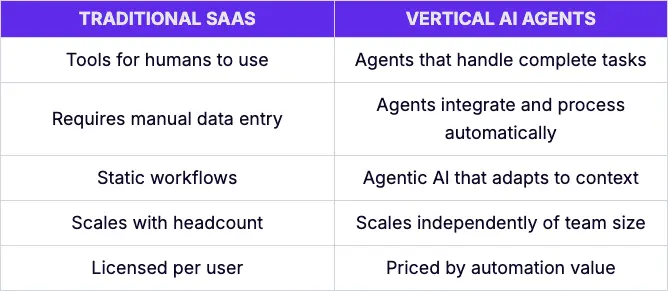
The challenges of vertical AI include domain expertise requirements and initial setup complexity. However, vertical AI agents provide measurable ROI through reduced operational costs and faster execution.
This evolution of vertical AI explains why investors and enterprise AI leaders view specialized agents as the future. Unlike general-purpose AI systems, vertical AI agents are designed to master specific domains, making them prime candidates for replacing repetitive, context-heavy work that currently requires human teams.
Getting Started with Vertical AI Agents
Start with processes that are:
Repetitive: The same workflow happens many times with slight variations
Context-heavy: Success requires information from multiple systems
Well-documented: Clear procedures, examples, and quality standards exist
Lower-risk: Mistakes are fixable rather than catastrophic
Sales intelligence, content creation, customer support, and research fit this profile. Start narrow with one workflow in one department. Prove consistent value before expanding.
What This Means for Your Business
Vertical AI agents represent a practical application of AI that delivers measurable results. They work because they're purpose-built for specific tasks, with smart information management that makes them efficient and accurate.
If you're dealing with repetitive, context-heavy workflows where consistency matters, vertical agents are worth exploring. The technology is ready, the patterns are proven, and the economics make sense.
The question isn't whether AI will handle these workflows. It's which workflows you'll automate first, and how quickly you can capture the efficiency gains your competitors are already seeing.